
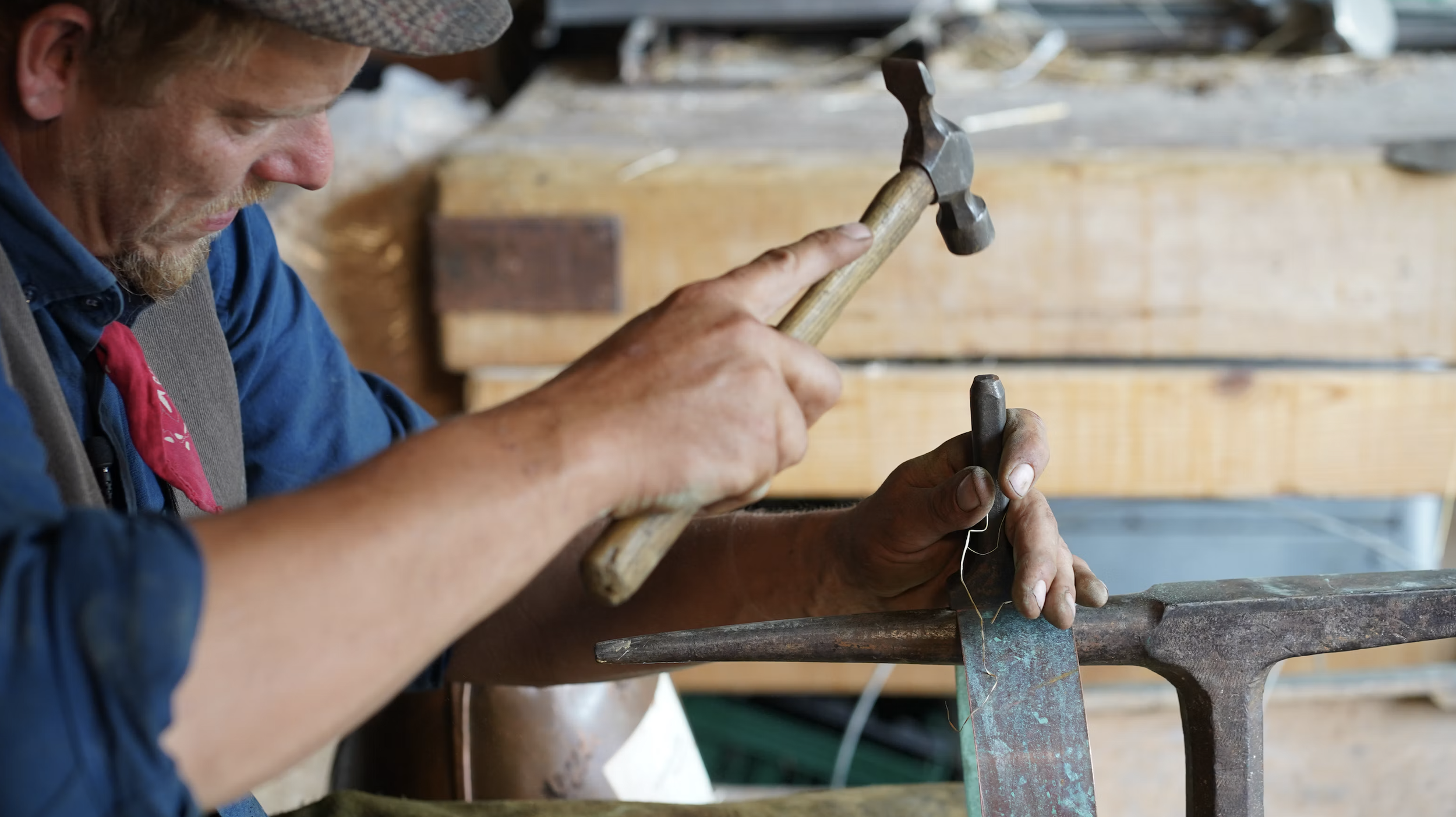
A maker does not sell a product the way a factory does. A factory sells an object. A maker sells a name, a pair of hands, and a story — and the object is the proof of all three.
Customers pay more for handmade work because they know who made it and how. They have seen the process, or they have read about it, or they have held a previous piece and felt the difference. That trust is the business. It is also the only asset a small maker has that cannot be undercut on price.
Which is exactly why it gets stolen.
Copiers don't copy your process. They borrow your reputation.
Nobody counterfeiting a handmade knife is spending years learning to grind, heat-treat, and finish a blade. Nobody faking a small-batch guitar is sourcing air-dried tone woods and voicing each top by hand. The copier skips all of it and goes straight to the part that sells: your name, your photos, your story, your price point minus a discount.
And the channels make it easy. A listing on a marketplace, a social media storefront, a website that looks just legitimate enough. The buyer is not an expert comparing grain patterns. They are someone who wanted your work, found something that looked like it for less, and clicked.
When that piece disappoints — poor materials, sloppy finish, no warranty, no maker standing behind it — the buyer does not blame the copier. They usually never learn a copier was involved. They blame you. The next time they consider your work, they hesitate. The next time someone asks about your brand, they pass on a bad experience that was never yours.
One fake in a run of fifty does more damage than one fake in a run of fifty thousand. In a run of fifty thousand, it is a rounding error. In a run of fifty, it is two percent of everything you made that year, attached to your name.
Paperwork separates from the piece. The piece is what circulates.
Makers already know how to document their work: certificates, signed cards, numbered editions, photographs of the build. All of it helps, and all of it has the same weakness. It sits beside the object, not in it.
Certificates get lost in moves. Cards get separated at resale. A listing can show your photograph next to someone else's product, and no buyer can tell from the screen. Years later, when a second or third owner wants to know whether the piece in their hands is really yours, the paperwork may be long gone — but the piece is still there.
That is the gap a physical marker closes. A covert DNA identifier is incorporated into the piece itself — into an ink, a coating, a dye, a resin, a label, or another compatible material, depending on what you make and how you make it. It is invisible in normal use, it does not change the appearance or the feel of the work, and it stays with the piece when the packaging is gone, the certificate is lost, and the listing has been taken down.
The record of your work can live wherever you keep it. The proof lives in the work.
Start with one product, not everything.
Authentication sounds like something for global brands with supply chains and legal departments. It does not have to be. A program for a maker starts the way a maker's work starts: with one piece, done properly.
Pick the product that gets copied, or the one with the highest value, or the one where questions already come up. Test the mark on your actual materials — your steel, your wood, your finish, your process — before anything goes into production. A demo on your real work answers the questions a brochure cannot: does it survive your process, does it change the appearance, can it be verified without damaging the piece.
If it works on that one product, you have a program. If it does not, you find out in an afternoon, not after a production run.
That is also how you answer the question every maker asks first: will this work on what I make? The honest answer is that it depends on the material and the process, and the only way to know is to try it on yours.
Your reputation took years. Protect it at the point of making.
You spent years building a name that customers trust. The mark takes that trust and puts it where it cannot be borrowed: into the piece itself, at the moment it leaves your hands.
So that when a buyer asks, years from now, whether the piece they hold is really yours — whether they bought it from you, inherited it, or found it on the resale market — the answer is not a story, a photograph, or a piece of paper that may or may not still exist.
The answer is in the work.